The Best Social Media Schedulers for Growing a Newsletter in 2026
Compare six schedulers by supported workflow, billing model, and newsletter measurement needs, with official sources and a practical trial checklist.
Choose a scheduler by completing a small version of your real workflow: draft the post, use the required format, schedule it to the right account, and inspect the newsletter signup path afterward. That tells you more than a general ranking.
Disclosure: we make Distinctful, which appears in this comparison. Our recommendations are interpretations of documented features. On September 7, 2026, we checked the official sources below and our current product definitions. We did not run a comparative uptime, writing-quality, or subscriber-growth experiment.
A shortlist by the work you need
| Tool | Documented starting point | What to check in a trial |
|---|---|---|
| Distinctful | Social publishing beside connected Beehiiv or Kit activity and supported offer context | Whether the plan exposes the newsletter and reader records you need |
| Buffer | Free plan for up to 3 channels, with 10 queued posts per channel | Required formats, account count, and paid reporting features |
| Typefully | Scheduling for X, LinkedIn, Threads, Bluesky, and Mastodon | Whether its editing workflow fits your actual drafts |
| Publer | Free and paid plans, with pricing based on connected accounts | Required networks and the paid requirement for X |
| Postiz | Hosted plans or self-hosted open-source software | Setup effort, app approvals, and ongoing operating costs |
| Hypefury | Its FAQ confirms LinkedIn, Instagram business accounts, and Threads; says X is no longer supported | Current platform and account requirements before migrating |
Sources: Distinctful integrations, Buffer pricing, Typefully scheduling, Publer pricing, Postiz pricing, and Hypefury's feature and pricing FAQ.
A supported network is only the first check. Verify the exact post format, account type, media, and approval flow you intend to use.
Read the billing units before comparing costs
Buffer: the checked Essentials quote for one channel is $60 billed yearly, displayed as $5/month. Its free plan's ten scheduled posts per channel are queue slots that refill after publication or deletion, not ten lifetime posts. Use the pricing selector for your actual account count and billing period.
Typefully and Publer: compare a quote for your required accounts and features. Typefully offers a free tier and paid plans. Publer's free tier excludes X; a free-plan comparison that depends on X would miss a material condition.
Postiz: the checked hosted Standard plan starts at $29/month for five channels. Self-hosting changes who operates the software. Its installation documentation describes the setup; the pricing FAQ also warns that network app approvals can require additional work. Include your maintenance time and infrastructure when comparing costs.
Distinctful: current prices and plan details are on pricing. Here is the annual arithmetic, kept separate from monthly billing:
| Plan | Billed monthly | Billed annually | Annual monthly equivalent | Saving against 12 monthly payments |
|---|---|---|---|---|
| Grow | $49 | $468 | $39 | $120 |
| Scale | $99 | $948 | $79 | $240 |
For example, Grow's saving is 12 × $49 − $468 = $120. These are subscription-price calculations, not a forecast of what the software will earn you. Publication, synced-subscriber, and credit limits still apply.
What Distinctful adds to the review
Distinctful combines social publishing with supported newsletter and offer information. Connect Beehiiv or Kit, review the available edition and subscriber data, and keep that context near the content you are planning.
Both plans provide full synced reader access within their limits, and automatic repurposing uses AI credits. Offer coverage depends on the checkout connection; Stripe availability also depends on the installation.
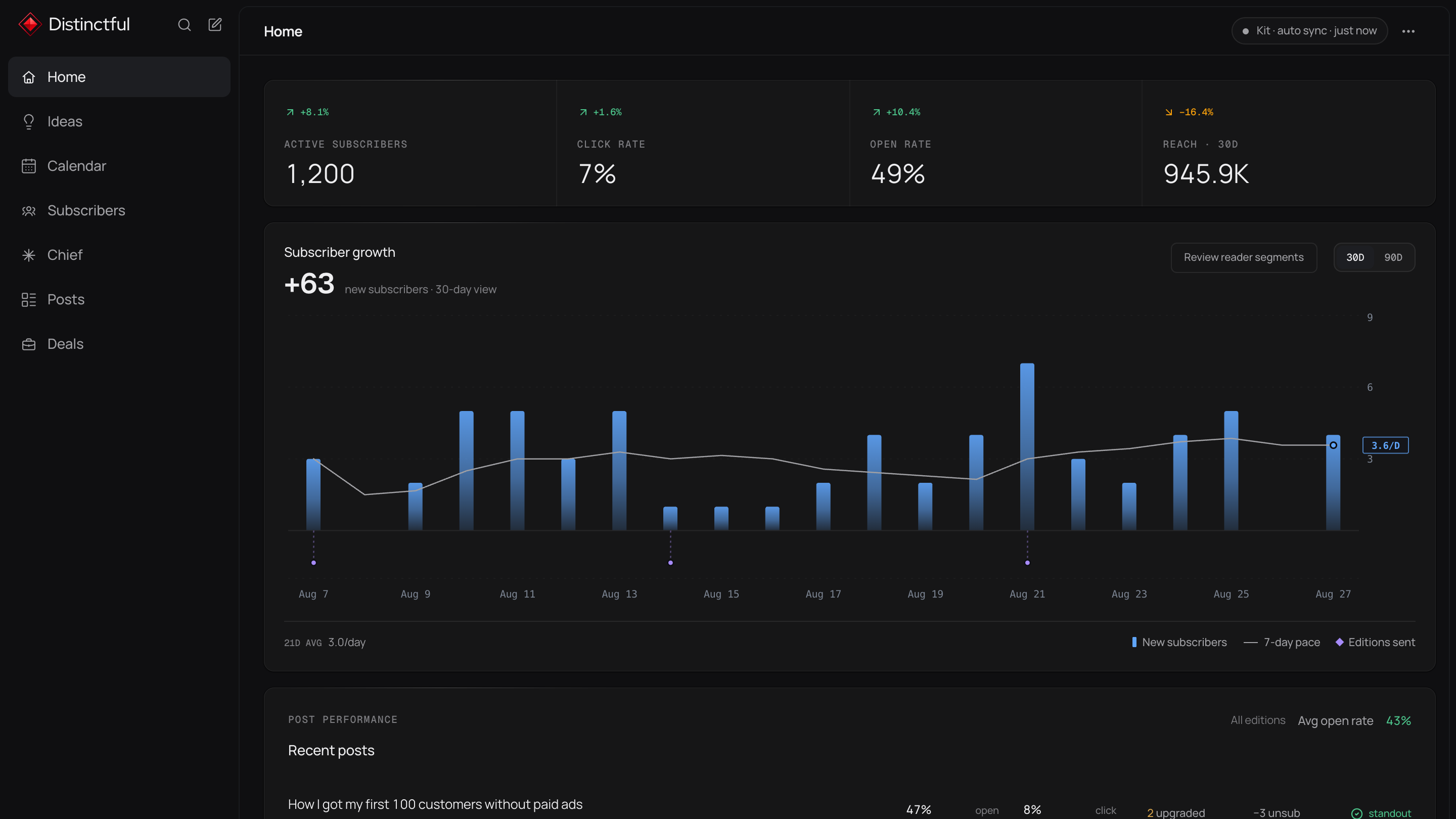
Interface illustration with sample data. Nearby publishing and subscriber figures support review; the chart is not evidence that a particular post generated those signups.
Other schedulers can be part of a measured newsletter workflow too. Buffer, for example, documents custom UTM parameters. Pair tagged links with a provider that preserves them, then test the signup path. Do not assume you need to replace a scheduler that already fits just to collect acquisition labels.
The LinkedIn signup walkthrough explains the test, including what remains unknown when a label is missing.
Try one post and one signup path
Use this checklist on each serious candidate and keep the same requirements:
| Trial step | Evidence to record |
|---|---|
| Connect the required account | Account type, permissions, and any missing format |
| Prepare one representative post | Text, media, links, and platform preview |
| Review the schedule | Timezone, intended account, and visible scheduled state |
| Publish a post you are ready to share | The resulting platform post or a clear failure to resolve |
| Test its newsletter link | Whether the destination and form preserve the campaign fields |
| Inspect the provider record | What source information was captured, with missing fields left unknown |
One successful test establishes that this path worked once. It does not establish months of reliability or a growth advantage over another product. Record the result and any unresolved condition before buying or moving your queue.
If publishing is covered and the next bottleneck is producing useful drafts, work through one edition into three social posts. If the missing step is reading newsletter and checkout figures together, use the weekly review example.
What this cannot tell you
- Documented features do not establish comparative reliability, writing quality, or newsletter growth. Test the workflow you actually need.
- Prices are a dated US-dollar snapshot at the stated billing period and account count. Confirm the final quote, taxes, and required features.
- Platform support depends on network, account type, format, permissions, and plan. A supported network does not imply every native feature is available.
- A preserved campaign label can support a signup comparison. It does not establish every influence on the reader or prove that a post produced a sale.
Questions
What is the best scheduler for growing a newsletter?
Choose around the work you need: network coverage, draft editing, scheduling, and the newsletter records you want to review afterward. Distinctful brings supported publishing and newsletter context together; Buffer, Typefully, Publer, Postiz, and Hypefury have different coverage and operating models. No documented feature list proves which will grow your list fastest.
How much does Distinctful cost?
At the October 3, 2026 check, Grow is $49 monthly or $468 annually, and Scale is $99 monthly or $948 annually. Both include publishing, Encore, automatic repurposing, Deals, full synced reader access, and Distinctful MCP, with publication, synced-subscriber, and credit limits varying by plan. Scale adds team members with their own logins and priority support.
What does Buffer's annual entry price mean?
The checked Essentials quote is $5 per month in equivalent cost for one channel, billed as $60 per year. That is an annual-billing quote. Recalculate for your channel count and chosen billing period before comparing it with a monthly subscription.
Does Hypefury still support X?
At this review, Hypefury's official pricing FAQ says it no longer supports X. Check its current support before moving an X workflow, even if older feature descriptions still mention Twitter.
Is self-hosting Postiz free?
The open-source software can be self-hosted, but hosting, maintenance, credentials, network app approvals, and any applicable provider costs still need to be considered. A zero software subscription is not a zero operating-cost guarantee.
Can I measure newsletter signups while using another scheduler?
Yes. Use tagged destination links with site analytics and a newsletter form that preserves the relevant fields. Verify the full signup path. A scheduler's social metrics and a provider's subscriber records describe different events, whether or not they appear in the same workspace.
Check the connections your workflow needs
Explore Distinctful's social and newsletter integrations, including supported data and setup requirements.
Related posts
HoneyBook vs Passionfroot for Creator Sponsorships
Choose HoneyBook for client projects or Passionfroot for sponsorship bookings. Compare agreements, delivery, payment fees, and a workflow for selling both.
Passionfroot Alternatives for Creators Managing Brand Deals
Choose a Passionfroot alternative by the work you need replaced: sponsor discovery, booking, paperwork, or delivery. Compare options and plan a careful switch.
Best Brand Deal Management Tools for Solo Creators
Choose a brand deal tool by the work you need: finding sponsors, tracking deliverables, or handling paperwork. Compare six options, costs, and practical limits.